Style of a Particular Time Have Had on a Work of Art We Are Considering
What'due south the central to understanding art? Could there be some easy steps to unpacking the meaning of an artwork?
The short answer is: yep.
I recently wrote an article for The Chat called Three questions non to enquire of fine art – and iv to ask instead, which tackled some age-old questions that get asked of fine art: Why is that fine art? What is it meant to be? Couldn't a four-year-quondam do that?
I suggested four better questions to ask, taken from Australian fine art academic Terry Smith.
Here's a unproblematic iii-footstep method I use, adjusted from an old technique by the art historian Erwin Panofsky:
ane) Look
2) See
3) Call back
The offset ii – wait and run into – are just about using your eyes, and observational skills. The third requires a flake of thought, cartoon on what nosotros already know and creatively interpreting what we've observed within an artwork's broader contexts.
When we see annihilation, whether it's a work of fine art, a movie or a billboard, our brains perform a massively complex split up-second procedure of reading and making meaning. We absorb a whole range of clues that make up our agreement of any image, many of which nosotros're not even conscious of.
Any process of understanding art, so, is nigh slowing downwardly that procedure, breaking down the image deliberately and holding off from jumping to any snap conclusions until subsequently.
Pace 1: Expect
Isn't it obvious we "look" at fine art? Not actually. When we visit a gallery, we tend to spend merely a few seconds in front of any i work. In fact, some estimates have it at under ii seconds.
And so look at what'south there, literally right in front of you. Outset with the nearly basic: what medium or material is it – a photograph, an object, a painting? How does information technology look? Crude and quick? Slick and neat? Shiny? Muddy? Advisedly made? Thrown together?
The artist will have made some very deliberate decisions about the materials, style and approach, and these volition feed direct into the overall feel and meaning of the work.
Look at this work by Spanish-born Australian artist Dani Marti called Information technology'southward all about Peter, made in 2009.
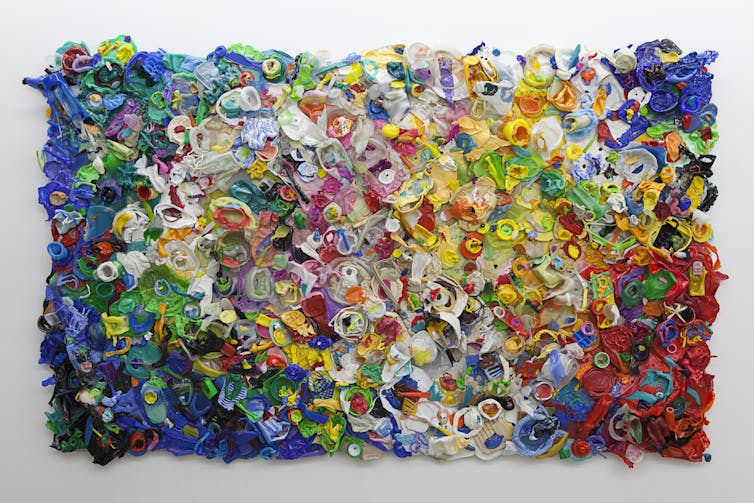
Information technology hangs on the wall similar a painting, but is made up of hundreds of melted plastic objects bowls, orange juicers, plastic domestic appliances, all different colours. Marti wants us to think of information technology in the tradition of a painting, fifty-fifty if it's made up of 3D plastic objects.
Step 2: See
What's the difference between looking and seeing in the context of art? Looking is near literally describing what is in forepart of you, while seeing is well-nigh applying meaning to it. When we come across we empathise what is seen as symbols, and we interpret what'southward there in front of usa.
Erwin Panofsky calls the symbols in an artwork "iconography", and whatever image tin can be hands broken down into the iconography that makes it up.
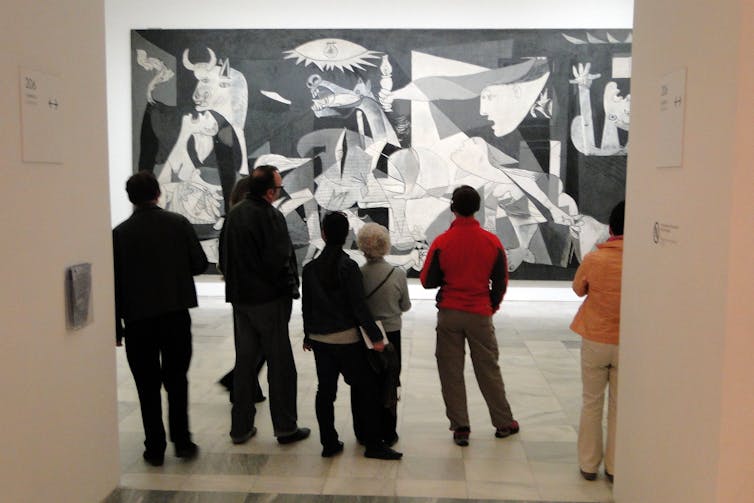
Consider the iconography in Pablo Picasso'due south epic painting, Guernica (1937). In the centre, there's that screaming equus caballus, with a dismembered arm just beneath it. On the left, a woman is wailing and holding a dead infant, and dominating the prototype is the low-cal shade that looks like an explosion. Those individual elements combine to produce the overall significant of the painting, which in this case is regarded every bit one of the most powerful anti-state of war art works created.
The iconography in Marti's It's all nearly Peter is not and then obvious – it's more abstracted, which means it's removed from a elementary literal depiction of something. Just the actual melted plastic objects are everyday items – things you might have in your home, the objects a person would surround themselves with that make up their life. Make a mental notation of iconography like this, and take information technology to the final step.
Step iii: Think
The terminal step involves thinking about what you've observed, cartoon together what yous've gleaned from the first two steps and thinking about possible meanings. Importantly, this is a process of estimation. It's non a science. It's not about finding the "right answers", only about thinking creatively nearly the most plausible understandings of a work.
The central here is context. The broader context of an artwork will help make sense of what you've already observed. Much of the data about context is commonly given in those tedious footling labels that tell you the artist's name, the title of the piece of work and the year. And there are oftentimes other valuable morsels of information included also, such as the place and year an creative person was born.

Who is the creative person? Is information technology someone whose work you lot know something about? If so, what exercise y'all know virtually them? Even if this is "Picasso was a womaniser", or "Jackson Pollock was a boozer", if y'all've heard of the creative person, you accept some existing knowledge you can bring to deport.
If you've never heard of the artist, what does his or her name advise about where they might exist from? Text panels in galleries normally accept the artist's dates and where he or she was born. These are important clues. Naturally, an artist born in the Soviet Wedlock in the 1930s is going to have very different life experiences from 1 born in Spain in the 1960s.
When was the work made? What do you know most what was happening at the time, even if information technology'due south this year? Text panels sometimes say where the artist works, and then where was the work fabricated? Artists produce work that responds to the earth they're immersed in every day, so the "when" and "where" will give clues as to what was happening.
Importantly, bring to bear everything yous know – you lot'd be surprised how much you lot know of the context of an artwork just from your general knowledge, a lot of which comes from conversations, television, the internet, all those things that are "informal learning".
In the example of Marti's Information technology's all almost Peter, the title is a major central. Marti is literally telling u.s. that this work is all almost someone called Peter. We might not know who Peter is, merely we do know from the title that this is a kind of an abstracted portrait of him – think of how the artist has hung this on the wall like a painting, wanting us to retrieve of the tradition of portraiture.
The iconography – those everyday plastic objects in this piece of work – are a portrait of "Peter", peradventure things owned past him, that say something almost the colours of the things he chooses to environment himself with. If this piece of work was a person, what could you say about them? Colourful and complex, perhaps? We're guessing. Merely we've unlocked that Information technology'due south all most Peter is a personal portrait about the creative person'southward connection with Peter.
Concord on …
You lot might be thinking, "hold on, if I did these three steps every fourth dimension I see a piece of work of art, it's going to take years to see everything in the gallery".
So hither'south an important tip – you don't take to await at (or like) everything. Yous don't like those Sometime Primary paintings of rich dead white people? Fine, don't waste your time on them. Alternatively, if you lot dearest that stuff and detest modern art, go wild.
Trying to run across everything in a major gallery in an hour is like going to a multiplex movie theater and trying to see all 12 movies in an hour by dashing from theatre to theatre. Nothing would make sense.
Myself, I love art that pokes me to remember differently about something I thought I already knew. Other people prefer eye candy. It's all valid.
Merely requite yourself a moment to slow downwardly, to look, see and think, and you lot'll discover something that really speaks to you.
0 Response to "Style of a Particular Time Have Had on a Work of Art We Are Considering"
Post a Comment