Review the Following Data From a Calorimetry Experiment
Qualitative Data
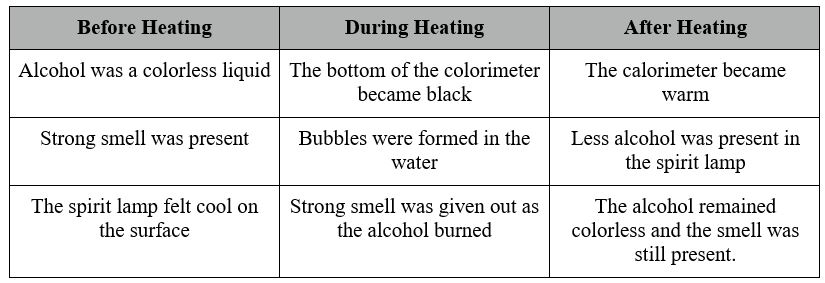
The same qualitative data was collected for all the alcohols.
In the experiment the paper lid was used in order to foreclose the water from evaporating from the calorimeter. The lid was constructed from paper-thin and attached to the calorimeter with adhesive tape. The hole was made for the thermometer leaving some space for the escapement of the heat.
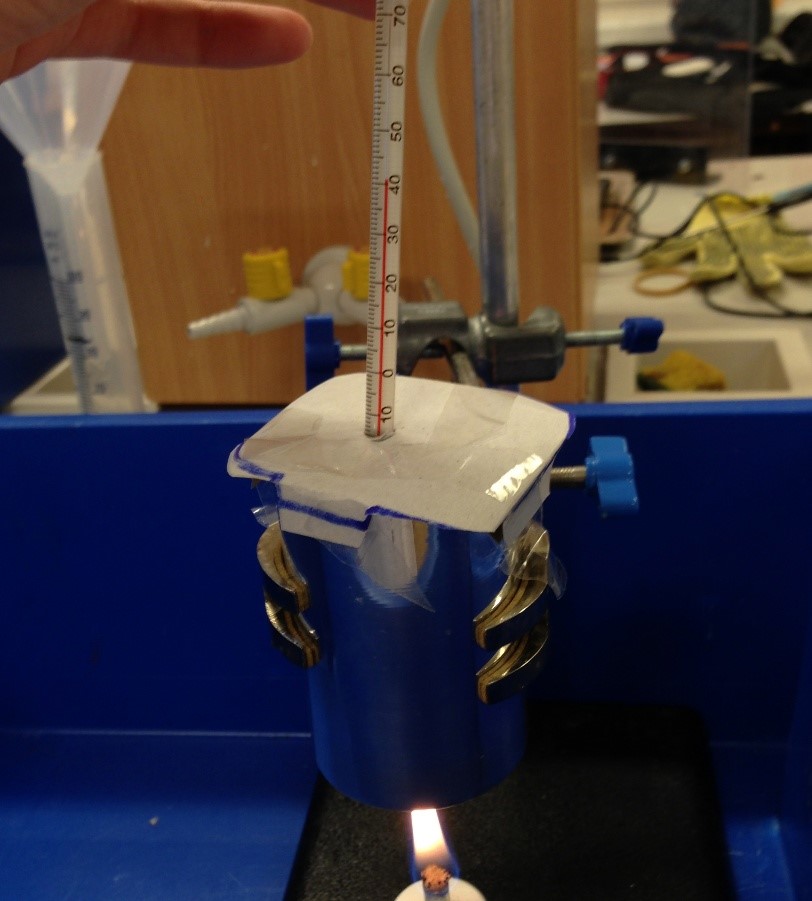
Furthermore, information technology prevented the exterior surrounding from affecting the results. In add-on a plastic container was used to reduce the result of the surroundings on the experiment past acting every bit an insulator from wind. This adds on to the accuracy of the processing.
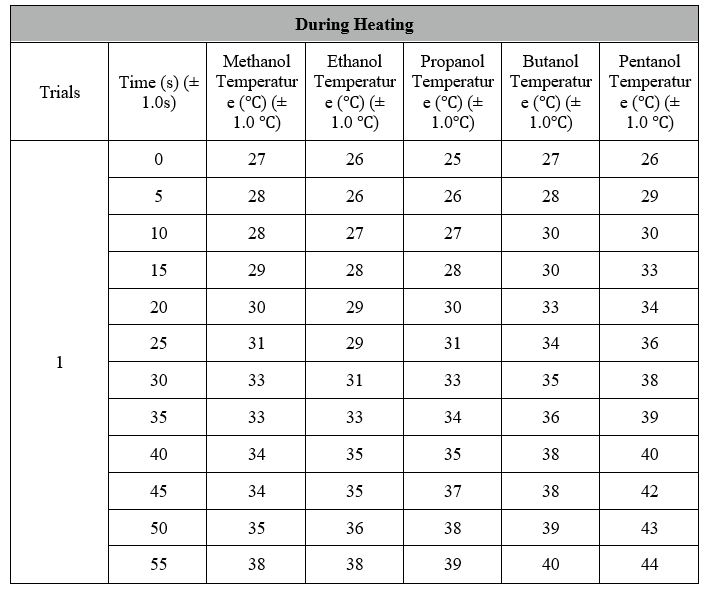
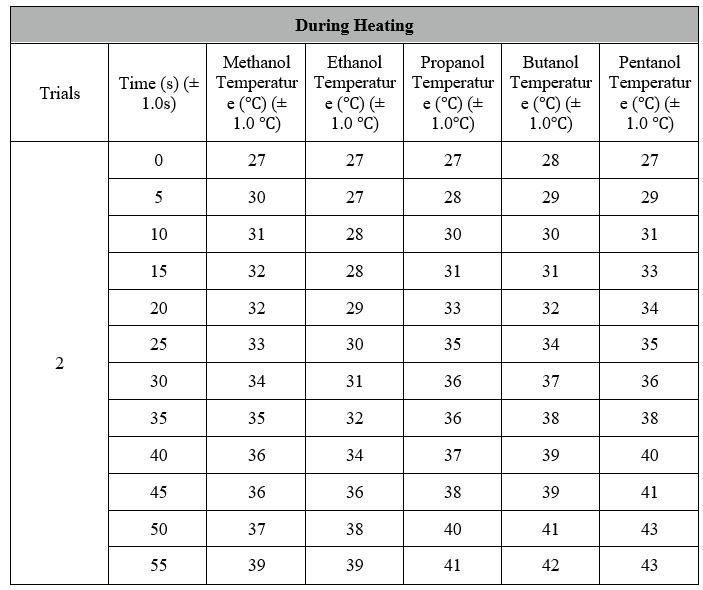
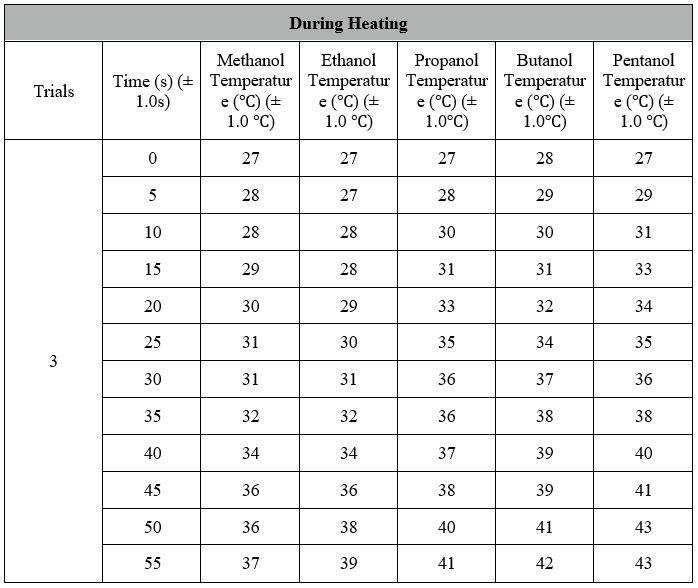
During Heating
Data Processing:
Enthalpy Change during combustion (∆H) = mc∆T
Methanol
Book of water = 100 cm3
Mass of H2o (m) = Book x Density
= 100 cm3 x 1 g/cm3
(thou) = 100 g
Temperature before Heating: 27 ℃
Temperature later Heating: 38, 39 and 37 degrees Celsius = 38℃ (Average for 3 Trials)
Full Change in Temperature: 38 ℃ – 27 ℃
(∆T) = eleven ℃
Specific Rut Capacity of Water = iv.18 J g-1 K-ane
Therefore:
Enthalpy Change = 100 g x 4.18 J g -one Chiliad -1 x 11 Grand
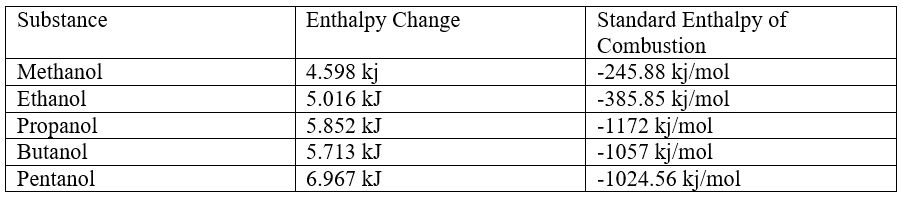
Enthalpy Modify = 4.598 kJ (Average for three Trials)
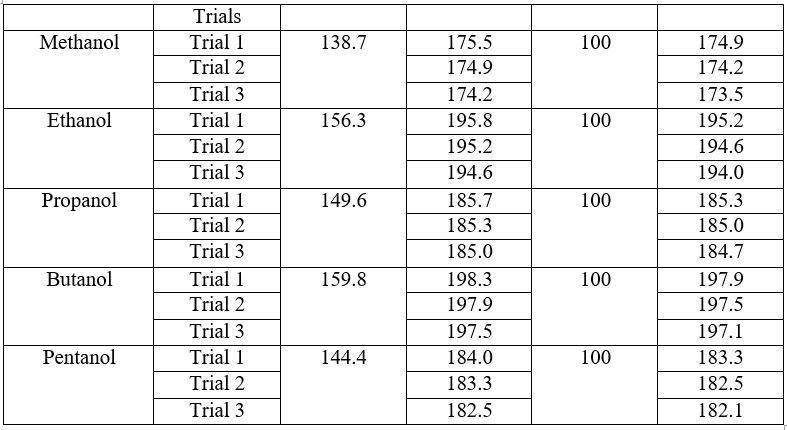
Mass of spirit lamp = 138.vii g
Mass of spirit lamp with methanol = 174. 9 + 174.ii + 173. 5 / 3 = 174.2 g (average mass calculated from the 3 Trials)
∴ Mass of Methanol burnt = (175.five – 174.ix) + (174.ix-174.ii) + (174-173.five) / iii = 0.6g
Molar Mass of Methanol = 12.0107 + (ane.00794 × 4) + 15.9994 = 32.04 thousand/mol (2 decimal places)
∴ Moles of Methanol burnt = Mass of Methanol
Molar Mass of Methanol
= 0.6g
32.04 g/mol
= 0.0187 mol (rounded to iii significant figures)
∴ Standard Enthalpy of Combustion of Methanol
= Enthalpy Change during combustion (∆H)
Number of Moles of Methanol
= 4.598 kJ
0.0187 mol
= 245.88 kJ/mol (rounded to ii decimal places)
Ethanol
Volume of h2o = 100 cm3
Mass of Water (m) = Volume 10 Density
= 100 cm3 x 1 g/cm3
= 100 m
Temperature earlier Heating: 26 + 27 + 27 / iii = 26.67 ℃ (Boilerplate for iii Trials)
Temperature after Heating: 38 + 39 + 39 / 3 = 38.67 ℃ (Boilerplate for 3 Trials)
Full Change in Temperature: 38.67 ℃ – 26.67 ℃ = 12 ℃
Specific Estrus Capacity of H2o = 4.18 J thousand -1 Thou -1
Therefore:
Enthalpy Modify = 100 grand x iv.18 J g -1 K -i x 12 K
Enthalpy Change = 5.016 kJ (Average for three Trials)
Mass of spirit lamp = 156.3 1000
Mass of spirit lamp with ethanol = 195.ii + 194.6 + 194.0 / 3 = 194.6 yard (boilerplate mass calculated from the 3 Trials)
∴ Mass of Ethanol burnt = (195.8-195.two) + (195.2-194.6) + (194.6-194) / 3 = 0.6g
Molar Mass of Ethanol = 46.07g/mol (two decimal places)
∴ Moles of Ethanol burnt = Mass of Ethanol
Number of Moles of Ethanol
= 0.6g
46.07g/mol (2 decimal places)
= 0.013 mol (rounded to three significant figures)
∴ Standard Enthalpy of Combustion of Ethanol
= Enthalpy Modify during combustion (∆H)
Number of Moles of Ethanol
= 5.016 kJ
0.013mol
= 385.85 kJ/mol (rounded to 2 decimal places)
The same procedures were made for the other 3 alcohols to summate the standard enthalpy and the results were put into the tabular array on the next page.
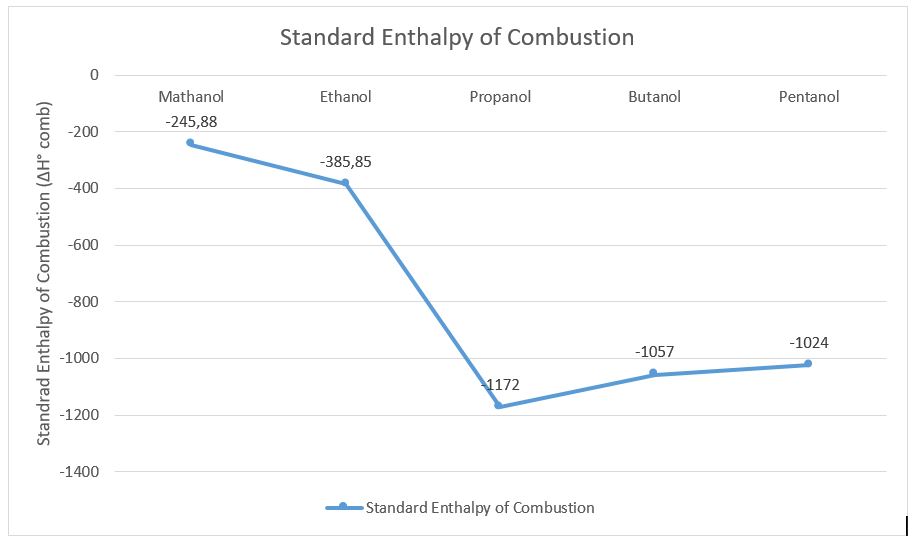
The graph higher up demonstrates the results of the standard enthalpy of combustion of the alcohols investigated in this experiment.
Published Results
Published results are used to compare the results with the literature results which have been proven.
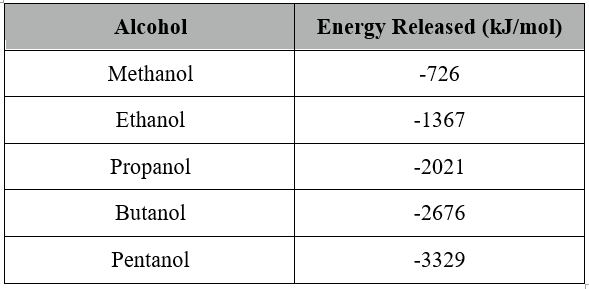
(CreativeChemistry.org, 2011)
When the literature results and obtained results from this experiment are plotted on the same graph information technology can exist seen that the results have a large error rate.
The published results and the graph on the previous page were used to calculate the percent error.
Methanol (the values of Standard Enthalpy of Combustion (∆H ̊comb) are positive for calculations)
Literature Value gathered from (CreativeChemistry.org, 2011)
= 726 kJ/mol
Value obtained from the experiment: 24.59 kJ/mol
Error Value = 726-24.59 = 701.41 kJ/mol
Percentage Fault = Mistake ten 100%
Literature Value
= 96.vi% (Rounded to one decimal place)
The same procedures were fabricated for the other four alcohols to summate the percent errors and recorded in the tabular array beneath.
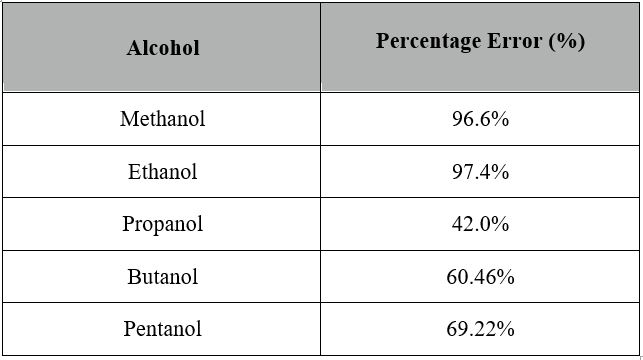
Although the per centum errors are relatively high, especially for Methanol and Ethanol, the results obtained are adequate. The random and systematic errors could all apply to the high percentage errors.
Error Propagation:
Methanol:
Uncertainty in the mass balance = 0.001 grand
Mass of methanol burnt = 0.6g ± 0.003 Percentage Uncertainty = 0.003g x 100% / 0.6g = 0.5%
Dubiety in the thermometer = 0.5℃
Temperature Difference = 11 ℃ ± i.5 ℃ Percentage Uncertainty = 1.5 ℃ x 100% = 13.64 %( rounded to 2 significant figures)
Dubiousness in the measuring of the volume = 0.5cm3
Volume of water = 100cm3 = 0.5%
Total uncertainty = 0.5% + 13.64% + 0.5% = 14.64%
Doubtfulness in kJ/mol = 14.64% of 24.59 kJ/mol = ± 3.threescore
The standard enthalpy of combustion of methanol including incertitude is:
24.59 kJ/mol ± 3.sixty kJ/mol
The same procedures were made for the other 4 alcohols to calculate the standard enthalpy of combustion of alcohols including uncertainties and the results were put into the table on the adjacent page.
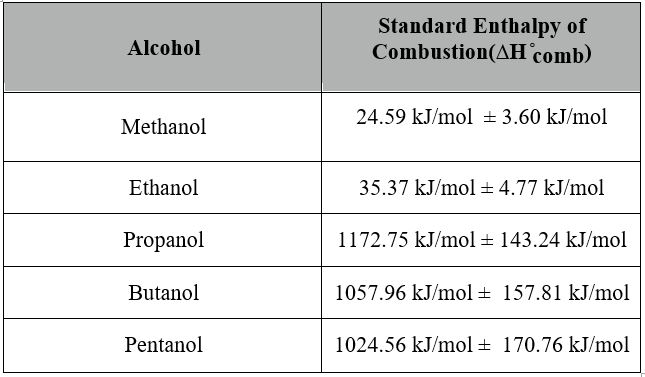
Conclusion:
The results which were obtained were unexpected equally the theoretical results show a linear relationship between the increasing number of carbons in the alcohol and increasing standard enthalpy of combustion. On the other mitt the results from this experiment testify a nonlinear human relationship with the anomaly in the standard enthalpy of combustion for Pentanol which is surprisingly college than the results for Butanol and Propanol.
The contrast between the theoretical values and observed values shown on the graph on page 11 of this report. The theoretical values emphasize the linear human relationship betwixt the enthalpy change and the increasing number of carbons in the booze. As a result it can be seen that methanol requires to the lowest degree energy to exist burnt and therefore it acts as a best source of fuel out of the 5 alcohols investigated in this experiment. The results obtained supports this argument as methanol has the everyman Standard Enthalpy of Combustion of the value 24.59 kJ/mol ± 3.60 kJ/mol. On the other hand according to the theoretical values the to the lowest degree efficient source of fuel out of the 5 alcohols is, Pentanol. However, the results show that the least efficient source of fuel is Propanol with the highest Standard Enthalpy of Combustion of the value 1172.75 kJ/mol ± 143.24 kJ/mol. The percentage errors were calculated to come across the difference between the literature results and the results obtained, furthermore, even though the pct errors were loftier it can be said that the results were satisfactory and the experiment was carried out carefully. The high error propagations calculated besides as high percentage errors could be recorded as a result of random and systematic errors, these errors are unpredictable and inevitable
There is a huge disparity between the published results and the results obtained from the experiment. This can exist attributed to the weaknesses and limitations that are associated with this experiment. The major weakness that is associated with the experiment is human error. Equally a result of errors in the collection of data, there a meaning disparity in the results obtained from the published results. Likewise, instrumental errors or errors associated with the uncertainty of instruments is a meaning factor in this huge disparity. The calorimeter becomes warmer later on heating and as a result the post-obit trials are affected by the increased temperature of the calorimeter which could affect the rate at which the h2o becomes hotter.
Furthermore, the same cardboard hat was used for all the trials, and by the end it might take been less efficient in preventing the external environment from affecting the experiment, as a result the last trials are not every bit authentic equally the previous ones. The purity of distilled water was used from different containers is questionable. This also adds on the inaccuracy, this could affect the content of the water and therefore consequence in the altered data nerveless.
The plastic container acted equally a shield for the experiment from the exterior environs, it as well prevented the wind from affecting the spirit lamp. These weaknesses also represent the limitations of the experiment. The quality of the instruments and the procedure employed in conducting the experiments compound the uncertainties and impurities that are in the experiment.
Evaluation:
It is evident that this experiment could exist carried out more accurately and efficiently due to the high pct mistake. Most of the errors and inaccuracies are preventable and can be easily stock-still by doing the following things:
Use a plastic cup which accurately closes the calorimeter therefore preventing the heat from escaping and preventing the exterior environs from affecting the experiment, such as temperature and the wind.
The metal calorimeter (copper) absorbed a large amount of heat from the experiment and the data was not collected. In the time to come the temperature of the calorimeter should be recorded and included in the error propagation calculations.
Many of the human errors tin can exist fixed past using the estimator data collector which establishes the authentic measurements of the temperature alter against fourth dimension. Furthermore, the distilled water and the measurement equipment should be used carefully and accurately.
Some systematic errors can be prevented easily by:
Make sure the thermometer is stirred to make sure the authentic temperature is collected. Also make sure that the thermometer does no touch on the lesser of the calorimeter to avert the false measurements.
The spirit lamp should be distinguished as presently as possible to avoid any loss of booze.
Investigate other alcohols and carry out more trials to obtain varied and further accurate results.
References
CreativeChemistry.org. (2011). Chemical science Lab Report. Retrieved Oct sixteen, 2013, from http://www.artistic-chemistry.org.united kingdom/gcse/documents/Module7/Northward-m07-24.pdf
Saunders, Due north. (2000). Chemistry Lab Study. Retrieved October sixteen, 2013, from http://world wide web.creative-chemistry.org.britain/gcse/documents/Module7/N-m07-24.pdf
erskinestionowl46.blogspot.com
Source: https://essays.io/combustion-of-alcohols-lab-report-example/
0 Response to "Review the Following Data From a Calorimetry Experiment"
Post a Comment